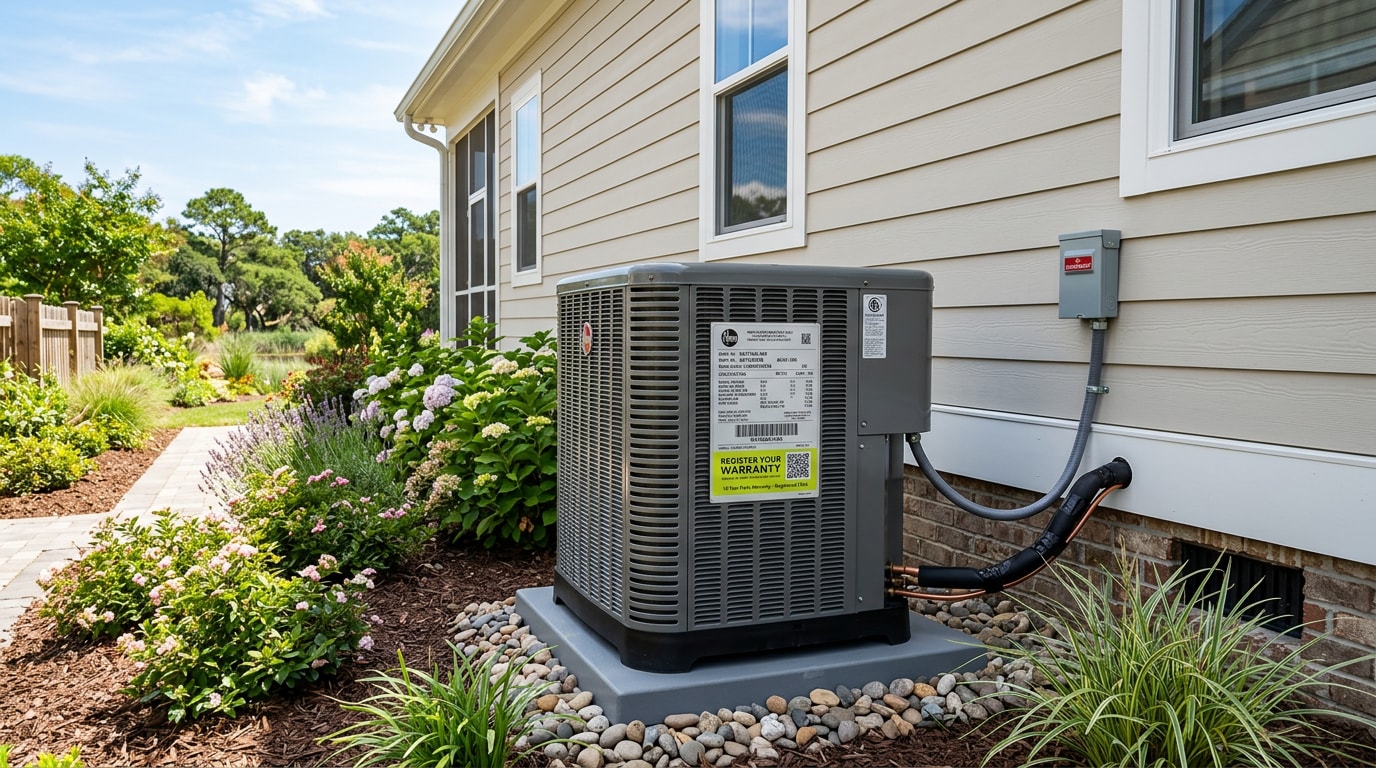
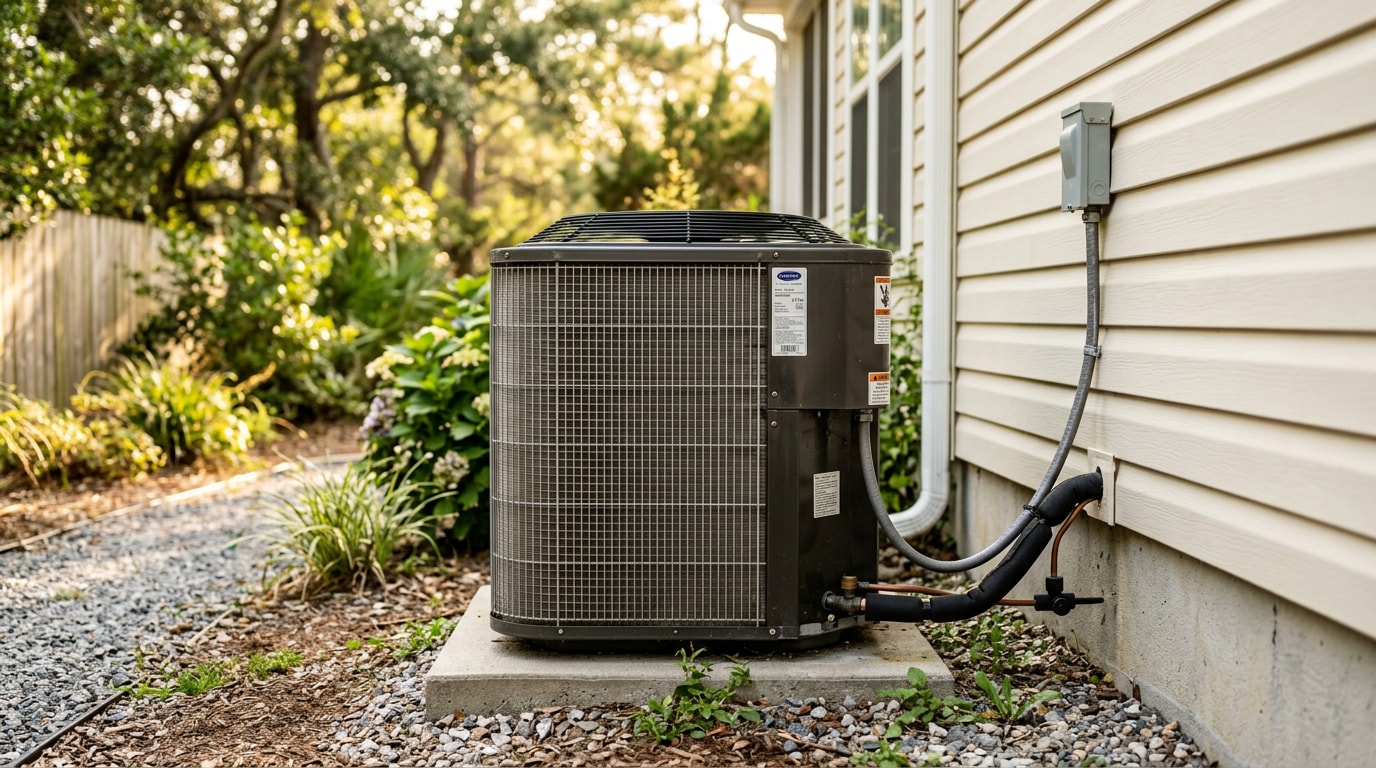
AC condenser vs compressor confusion sends plenty of Morehead City, NC homeowners down the wrong repair path every summer. These two outdoor unit parts work together, but a technician chasing the wrong one can cost you time and money on a repair that never fixes the real problem. This guide breaks down what each component actually does, how Crystal Coast salt air ages them differently, and when repair still beats a full replacement.
What Is an AC Compressor?
Every cooling cycle starts here. Before refrigerant can absorb or release heat anywhere else in the system, it passes through the compressor first.
The compressor is a pump-like component inside the outdoor unit that squeezes low-pressure refrigerant gas into a hot, high-pressure vapor. That pressure jump raises the refrigerant's temperature above the outdoor air temperature, which is the only way heat can flow out of it once it reaches the coil.
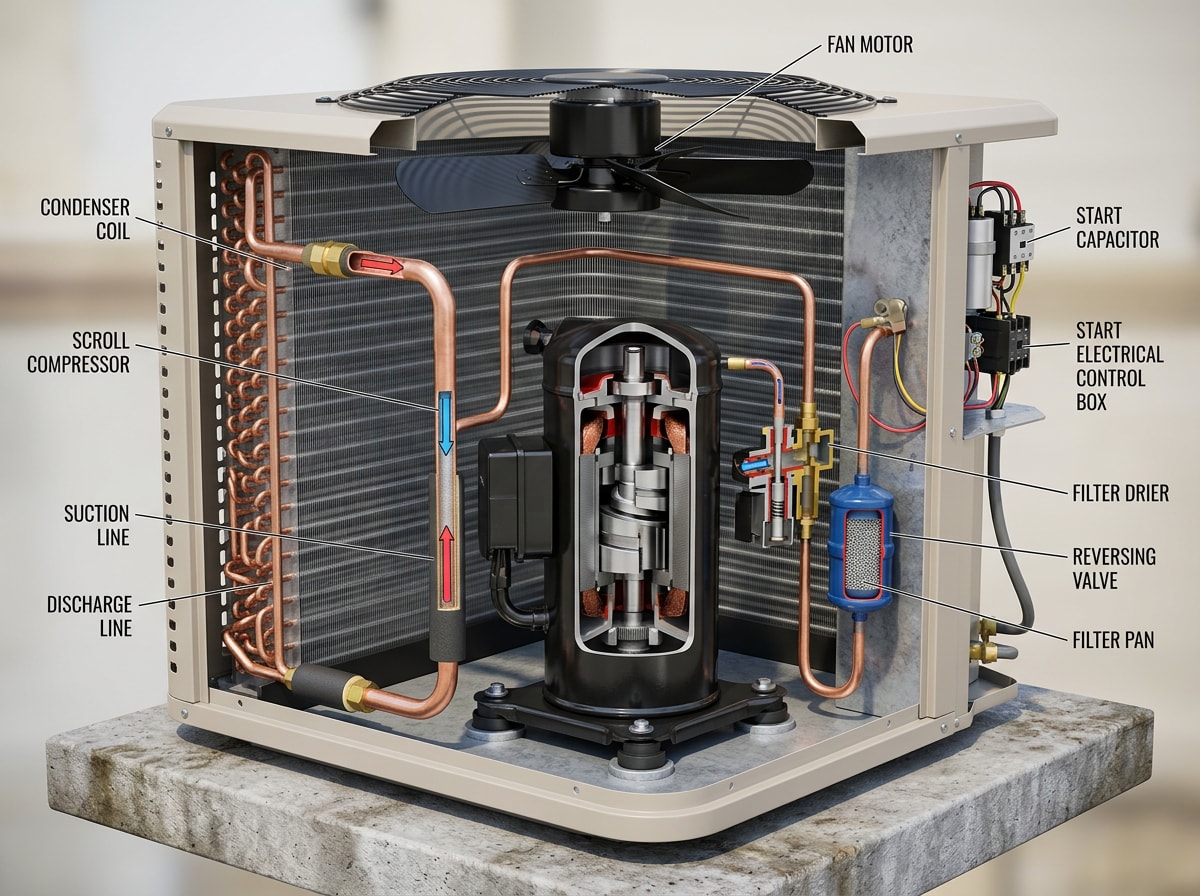
If the compressor fails, the entire refrigeration cycle stops, no matter how clean or well-maintained the rest of the system is. A failing compressor needs professional air conditioning repair to diagnose correctly rather than guesswork, since a misdiagnosed compressor repair is one of the most expensive mistakes a homeowner can make.
What Is an AC Condenser?
The condenser picks up where the compressor leaves off. If the compressor is the pump, the condenser is the radiator, the half of the system responsible for releasing the heat collected indoors.
Once hot, high-pressure gas leaves the compressor, it enters the condenser coil, a series of finned tubes mounted in the outdoor unit. A condenser fan pulls outside air across these coils, creating the heat exchange that cools the gas enough to condense it back into a liquid. That liquid then travels to the expansion valve, where pressure drops sharply and the cycle starts over.
The coil's performance depends entirely on clean airflow and intact fins. Dirt, debris, or bent fins reduce its ability to shed heat, forcing the whole system to work harder. If a coil is damaged beyond repair, a full system replacement is often more cost-effective than patching it piece by piece.
AC Condenser vs. Compressor: Key Differences
Now that you know what each part does individually, the differences, and how closely they depend on each other, become easier to see.
| Feature | AC Compressor | AC Condenser |
|---|---|---|
| Primary function | Pressurizes refrigerant gas | Releases heat, condenses gas to liquid |
| Location | Center of outdoor unit | Surrounds compressor, outer coil |
| Key components | Motor, pistons/scroll, electrical terminals | Coil, fins, condenser fan |
| Role in cycle | Starts the high-pressure stage | Completes the heat-rejection stage |
| Common warning signs | Humming, hard starts, warm air | Dirty coils, overheating, weak airflow |
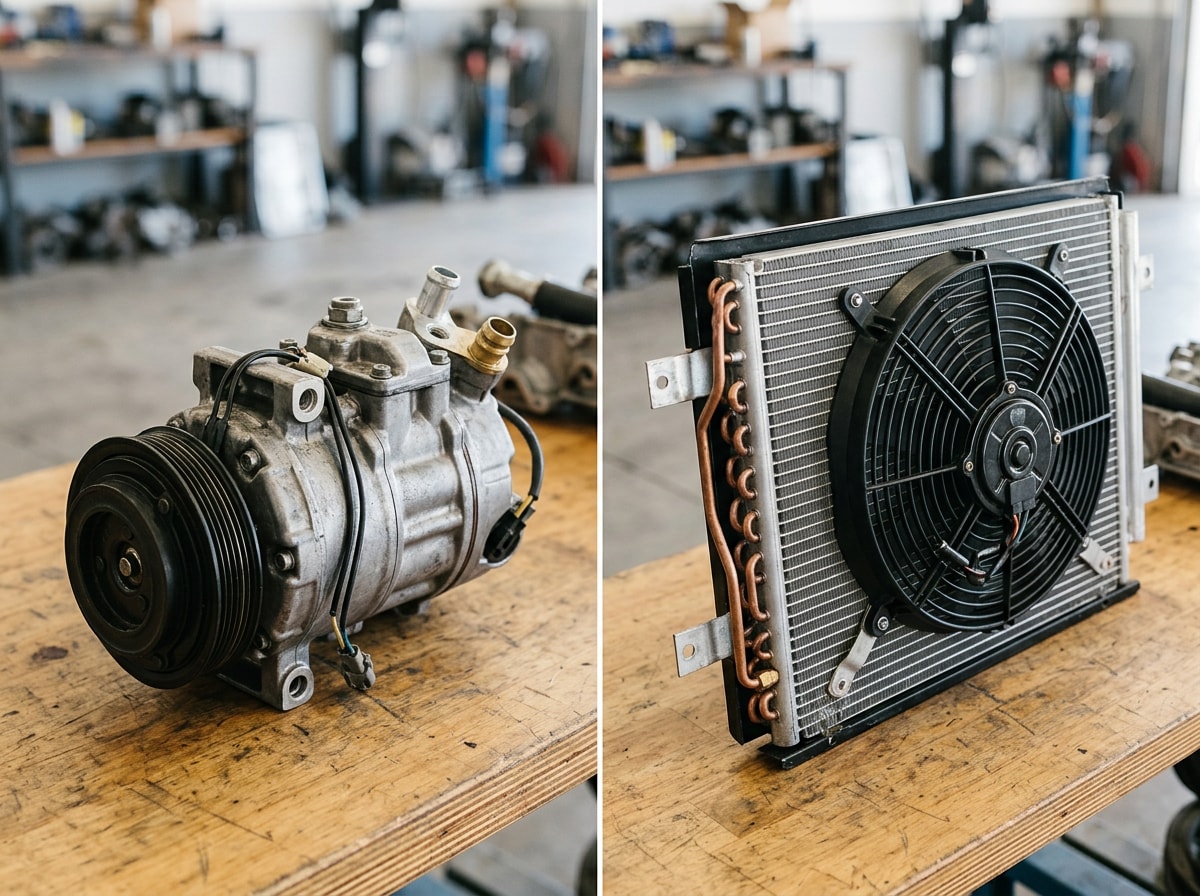
Despite their differences, the compressor and condenser work as a single, sequential system. Neither can do the other's job. The compressor pressurizes refrigerant and pushes it toward the condenser; the condenser cools that gas through heat transfer with outdoor air, turning it back into liquid before it heads indoors to absorb heat again. This hand-off repeats continuously, dozens of times per hour on a hot Carteret County afternoon. If either part underperforms, the other works harder to compensate, which is often why both show stress symptoms around the same time.
How Salt Air Changes the Timeline on the Crystal Coast
This is where Morehead City homeowners deal with something the national AC guides rarely mention: salt-driven corrosion doesn't age a compressor and a condenser at the same rate.
Corrosion of air conditioner outdoor heat exchangers poses a significant problem for consumers living in coastal regions, and researchers at Texas A&M specifically studied galvanic corrosion on condenser coils exposed to high-salt environments along the Gulf coast.
The coils tested were built from copper tubing and aluminum fins, the same combination found in most residential condensers, which form a galvanic couple once salt water acts as an electrolyte. The results were measurable, not theoretical: sensible and latent capacity degradation for the tested units showed decreases of approximately 4.6% and 20.9%, while system EER dropped by 11.5% for one unit and 8.3% for the other over the course of the field investigation.
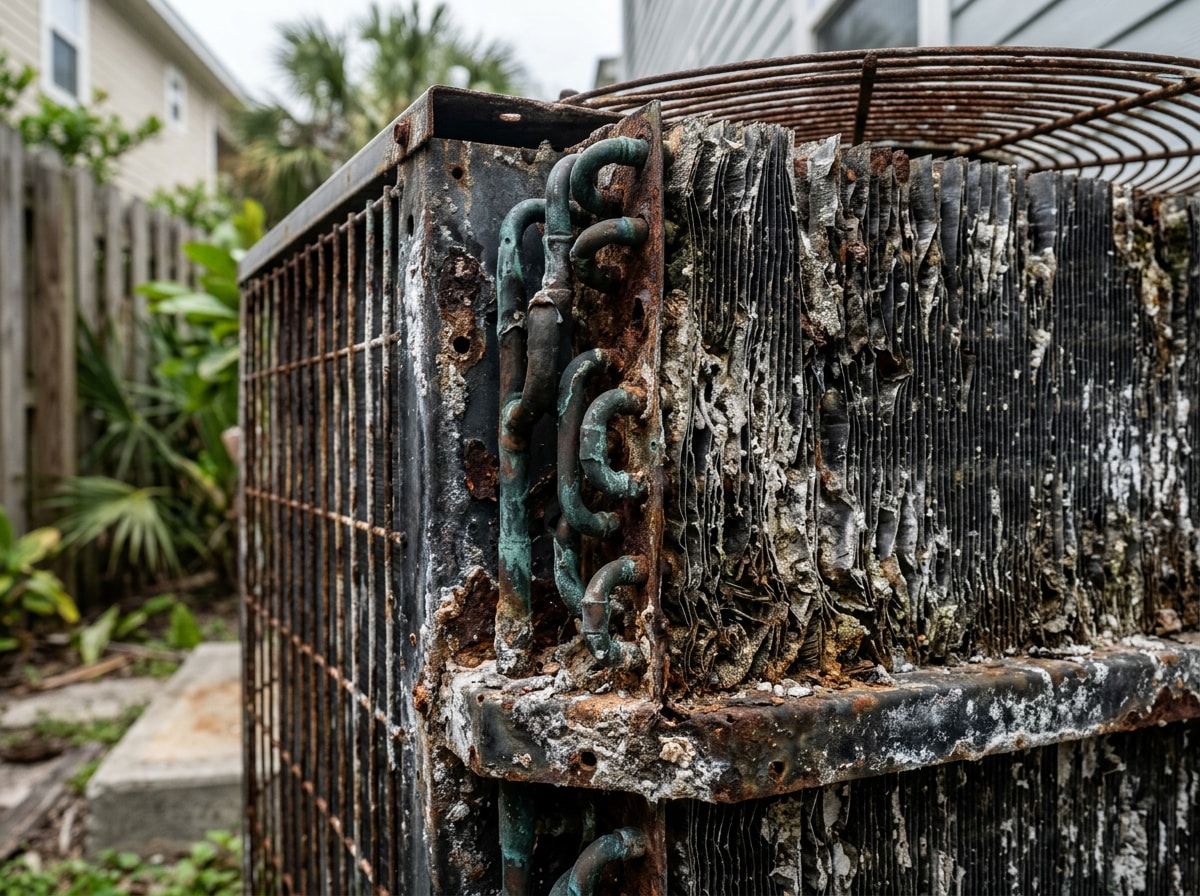
That is the practical reason condenser coils near Bogue Sound and the waterfront often show pitting and corrosion years before the compressor inside the same cabinet shows any sign of strain. The coil is the first metal surface the salt-laden air touches. We see this pattern on service calls throughout Morehead City, Atlantic Beach, and Pine Knoll Shores: a 7 or 8-year-old condenser coil needing replacement while the compressor underneath still tests fine.
Carrier notes that with proper maintenance, a well-built AC condenser typically lasts 15 to 20 years, but coastal environments or lack of maintenance can shorten that lifespan considerably. Routine coil cleaning and a protective service plan through HVAC maintenance is the single biggest lever homeowners near the water have to slow that process down.
Warning Signs: Is It the Compressor or the Condenser?
Because the compressor and condenser work in sequence, symptoms overlap more than most homeowners expect. Here's how to tell them apart before calling for service:
Signs pointing to the compressor:
- Humming sound but the unit never actually starts
- Hard starting, or the outdoor unit clicking repeatedly before running
- Warm air blowing from vents even though the fan runs
- Breaker trips tied to the outdoor unit
Signs pointing to the condenser:
- Visibly dirty, bent, or corroded coil fins
- Outdoor unit running hot to the touch
- Weak airflow from the condenser fan
- Longer run times without reaching set temperature
Guessing which part failed without testing refrigerant pressure and electrical components usually means paying for the wrong repair first. EPA guidance makes clear that certification is required for anybody who, in the course of maintenance, service, or repair of an appliance, could be reasonably expected to violate the integrity of the refrigerant circuit and release refrigerant into the environment , which is exactly why refrigerant-side diagnosis should go to a licensed HVAC contractor rather than a DIY fix. Homeowners throughout Morehead City, NC can have a system evaluated before a small issue turns into a bigger bill. If you're dealing with a no-cool emergency right now, our guide to affordable air conditioning repair in Morehead City walks through what same-day service typically involves.
Repair or Replace? How Morehead City Techs Decide
Not every failure means the whole system needs replacing. A capacitor, a fan motor, or a section of coil can often be repaired for a fraction of replacement cost. The right call depends on the system's age and overall condition, not just which part failed.
Replacement usually makes more financial sense once:
- The system is 10 to 15 years old
- It has needed frequent repairs in the last two years
- Energy bills have climbed steadily without a usage change
- A major failure, like a seized compressor, has occurred
- Cooling performance stays weak even after a repair
Installation problems like oversizing, improper charging, and leaky ducts result in efficiency losses, occupant discomfort, and shortened equipment life , according to the U.S. Department of Energy, which is why a full system evaluation (refrigerant pressure, electrical components, airflow) matters more than guessing based on symptoms alone. Request a free estimate and we'll tell you honestly whether a repair or a replacement makes more sense for your specific unit.
Compressor vs Condenser Repair Costs
Compressor replacement is typically the more expensive repair. The job usually involves refrigerant recovery, specialized labor, and sometimes a full system recharge, so cost varies significantly based on unit size and whether the compressor is still under manufacturer warranty.
Condenser repair cost depends heavily on which part failed. A fan motor or capacitor is a relatively minor fix, while a full coil replacement costs considerably more. Rather than comparing price alone, weigh the repair against the system's remaining lifespan. A major repair on a 12-year-old system near the water, where coil corrosion is already accelerated, may cost nearly as much as starting fresh with new equipment.
Every situation is different, and the only way to get an accurate number is a hands-on inspection. Get a free estimate from our team before committing to either repair path, and visit our homepage to see the full range of heating, cooling, plumbing, and electrical services we offer across the Crystal Coast.
FAQ
Is an AC compressor the same as an AC condenser?
No. The compressor is a single component that pressurizes refrigerant gas. The condenser is the outdoor coil and fan assembly that releases heat. In everyday conversation "condenser unit" often refers to the whole outdoor cabinet, which houses both the compressor and the condenser coil, but they are two distinct parts with different jobs.
How do I know if my AC compressor or condenser is bad?
A bad compressor usually causes humming without startup, hard starting, clicking noises, or warm air from the vents. A bad condenser more often shows up as poor cooling, an overheating outdoor unit, visibly dirty or corroded coils, and longer run times. Because symptoms overlap, a technician typically needs to test both components to confirm which one failed.
Should I replace an AC condenser when replacing a compressor?
Not always. It depends on the condenser's age and condition, remaining warranty coverage, and how old the overall system is. If the condenser coil is relatively new and undamaged, a technician can often replace just the compressor instead of the whole outdoor unit.
What is the lifespan of an AC condenser on the NC coast?
Inland, a well-maintained condenser can run 15 to 20 years. Near saltwater, coil corrosion often shortens that window, sometimes requiring a coil replacement well before the compressor shows any wear. Regular coil cleaning and keeping airflow clear of debris are the most effective ways to extend that lifespan in a coastal climate.
Which is more expensive, a compressor or a condenser?
Compressor replacement is usually the pricier fix because of its central role, the labor involved, and the required refrigerant recovery. Condenser repairs vary widely depending on whether it's a fan, a capacitor, or a full coil that needs attention.