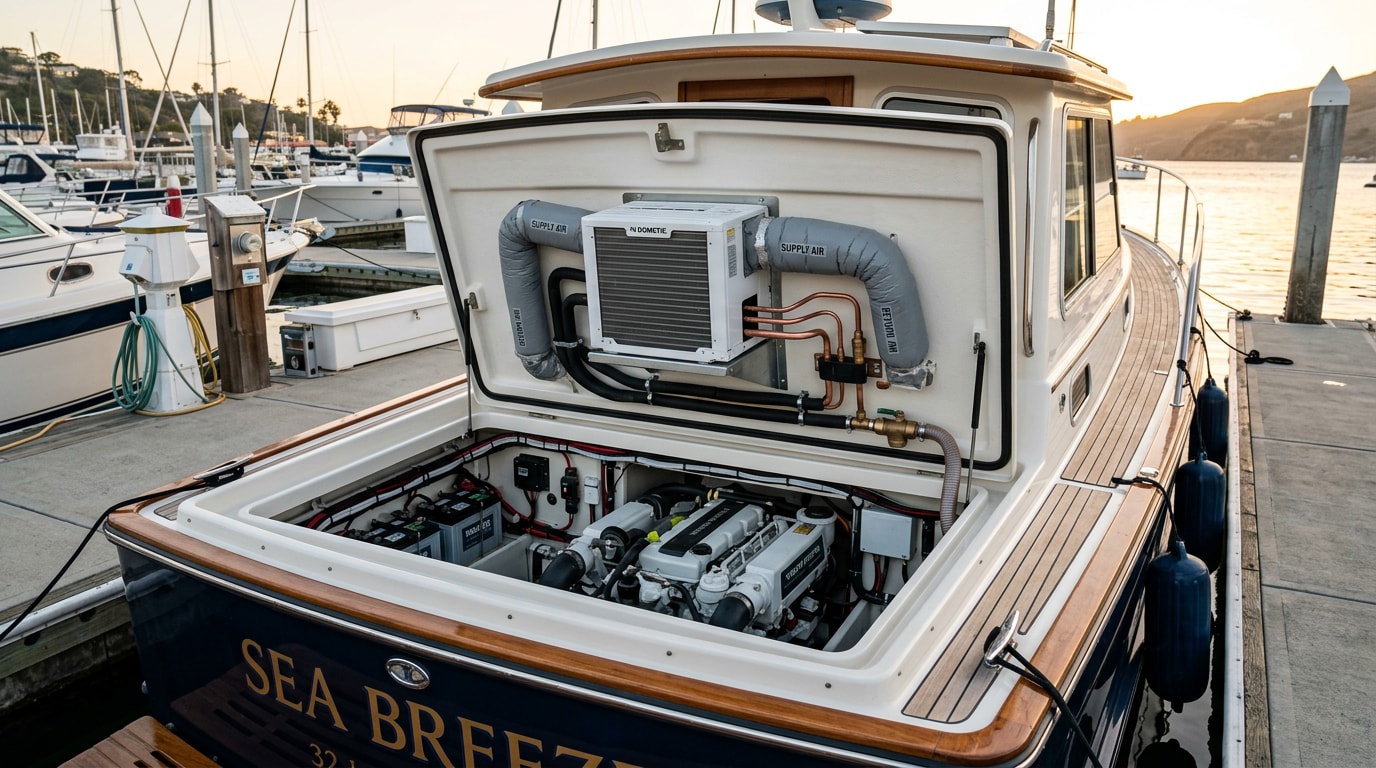
Marine air conditioning in Cape Carteret, NC has to survive seawater, salt fog, and a cabin the size of a closet, conditions home AC units never see. This guide covers how boat AC actually works, how to size it correctly, and what installation costs in 2026, so you aren't guessing before summer hits Bogue Sound.
How Does Marine Air Conditioning Work?
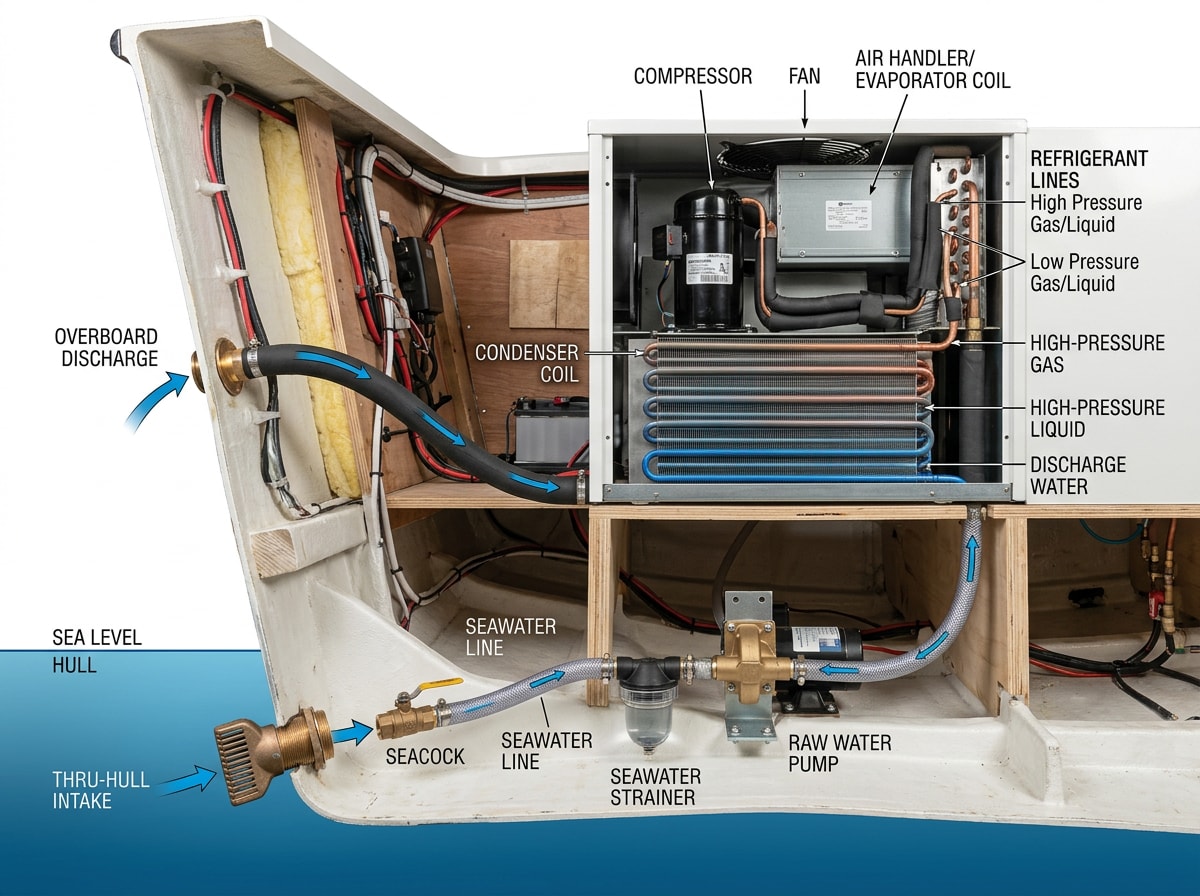
A home AC unit dumps heat into outside air. A boat doesn't have that luxury in a sealed, insulated cabin, so marine AC rejects heat into seawater instead.
That single difference is why a boat's system can stay compact and quiet even when it's working in a space with almost no outside airflow.
Here's the basic cycle:
- Raw water enters through a thru-hull and strainer.
- It flows across the condenser, absorbing heat from the refrigerant.
- The warmed water pumps back overboard.
- Meanwhile, refrigerant cycles through compression and expansion to pull heat and moisture out of the cabin air.
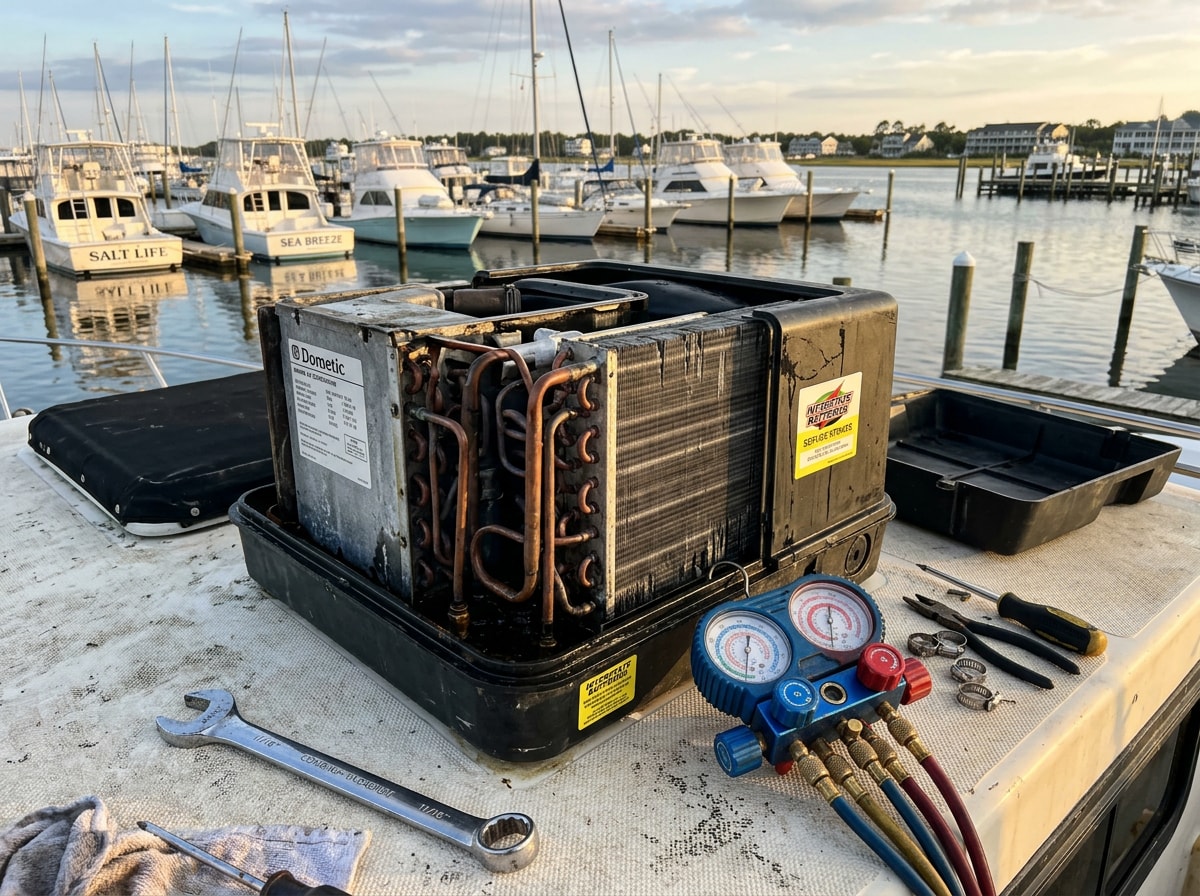
Most marine AC complaints trace back to that raw water side, not the refrigerant side. A clogged strainer or weak pump kills performance long before anything mechanical actually fails.
What Are the Primary Components of a Marine AC System?
Every marine AC system, regardless of size, relies on four core parts:
- Compressor: pressurizes refrigerant gas
- Condenser: releases heat into seawater
- Expansion valve: drops pressure and temperature sharply
- Evaporator: absorbs heat from cabin air as a blower pushes air across it
The expansion valve is the part most owners never think about until it fails. It meters liquid refrigerant and creates the steep temperature drop that makes the evaporator cold enough to pull both heat and humidity out of the air. For a closer look at which individual parts tend to fail first and what they cost to replace, see our guide on air conditioning parts in Cape Carteret, NC.
Why Cape Carteret's Salt Air and Humidity Push Marine AC Harder
Boats moored along Bogue Sound or running the Intracoastal Waterway near Cape Carteret deal with salt fog and heavy summer moisture almost nonstop from May through October. Relative humidity readings along the Carteret County coast commonly climb into the 90-percent range during warm, wet weather , and July rainfall alone recently topped four inches in a single month for the area. National Weather Service data for Morehead City logged 4.17 inches of rain that month , which is the kind of moisture load that keeps a marine AC's dehumidification duty running far longer than it would inland.
Salt-laden air also accelerates corrosion on condensers, thru-hulls, and electrical connections faster than almost anywhere else on the East Coast. That's a big part of why reputable marine AC installers build to ABYC A-6, Refrigeration & Air Conditioning Equipment , a recognized industry standard rather than guesswork.
Our technicians who service coastal HVAC equipment along this stretch of the Crystal Coast see the same early warning sign over and over on seawater-cooled systems: water flow drops off weeks before anyone notices a refrigerant problem. Catching that early is usually the difference between a $150 strainer cleaning and a replaced compressor.
Types of Marine AC Systems
Boat size and cabin layout largely decide which configuration makes sense. Smaller cruisers lean toward compact, self-contained units, while larger yachts often need distributed or centralized cooling.
Self-Contained Units
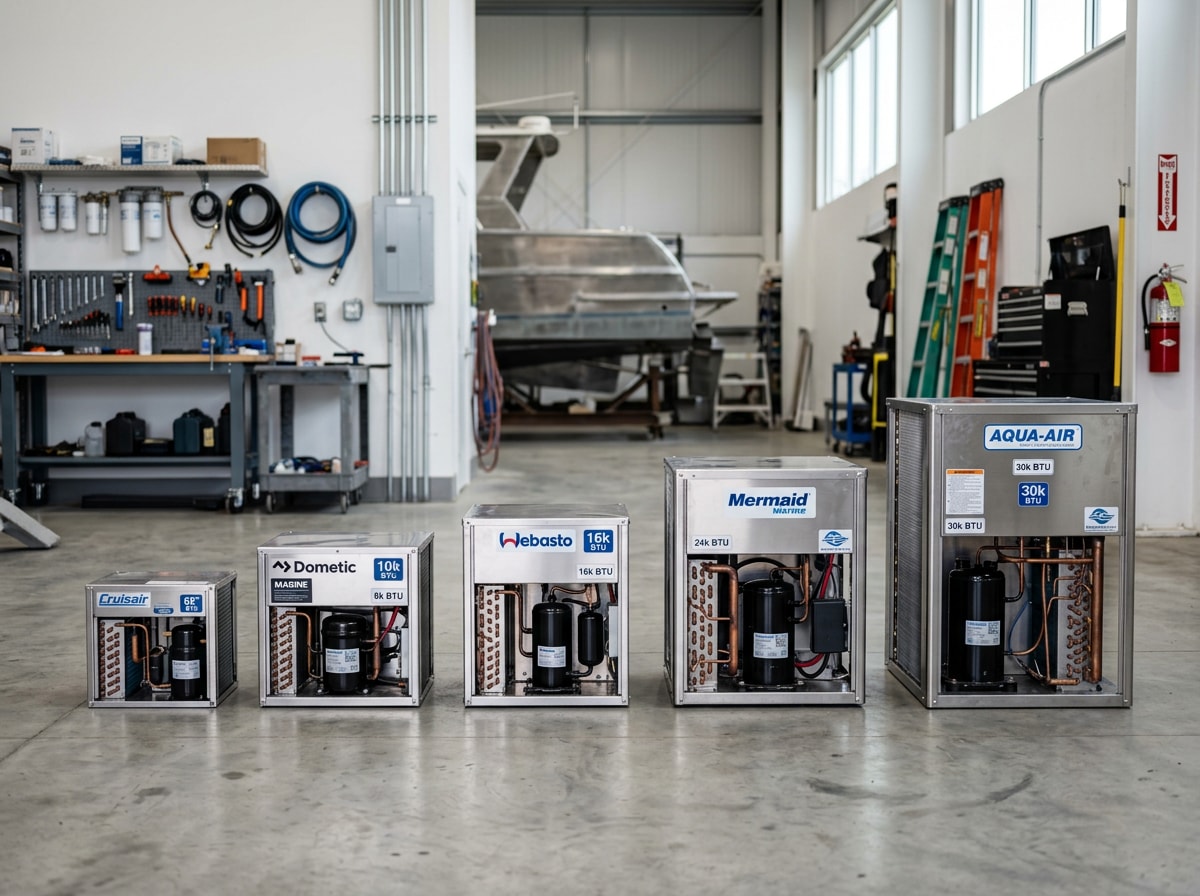
Everything, compressor, condenser, blower, and controls, packs into one chassis that tucks under a berth or settee. These units typically run 5,000 to 24,000 BTU and suit most boats under 45 feet.
Installation stays simple: one unit, one thru-hull, one return air path. For single-zone boats, this is usually the most cost-effective option available.
Split Systems (Remote Condenser Units)
Here, the noisy, heat-generating hardware moves out of living space entirely. The compressor and condenser sit in a machinery space or lazarette, while a separate air handler delivers conditioned air inside the cabin.
Cabin noise drops noticeably, and living space opens up. Owners who found their self-contained unit too loud at anchor tend to upgrade to this setup next.
Chilled Water Systems
Yachts in the 50-foot-plus range usually go chilled water. One central chiller cools a water-glycol loop that feeds an air handler in each zone, so every stateroom can run its own temperature.
Installation costs more and takes longer, but the payoff is quieter operation and real zone control. This system type is uncommon on boats typically docked around Cape Carteret, but it's worth knowing if you're shopping for a larger vessel.
How Many BTUs Does Your Boat Need?
Getting sizing right matters more than almost anything else for comfort aboard a boat. Undersize it, and the unit never catches up on a humid July afternoon. Oversize it, and it short-cycles, leaving the cabin cold but still clammy.
Start with cabin volume (length × width × height), then adjust for sun exposure, insulation, occupant count, and electronics heat load. Coastal North Carolina's humid, muggy summers generally call for sizing toward the higher end of standard calculators rather than the bare minimum.
| Cabin Size (approx.) | Temperate Summer BTU | Peak Humidity Months BTU |
|---|---|---|
| Small cuddy cabin (20–25 ft) | 5,000–8,000 | 8,000–10,000 |
| Mid-size cruiser (28–35 ft) | 10,000–12,000 | 12,000–16,000 |
| Larger cruiser (36–45 ft) | 16,000–18,000 | 18,000–24,000 |
These ranges are general guidance, not a substitute for a real load calculation, since insulation quality and window area vary a lot between boats of the same length.
Thermostats and Controls: Keeping the Cabin Comfortable
Marine AC controls have moved well past the old mechanical dial. Many current systems offer digital displays, programmable schedules, and app-based climate control that lets you pre-cool a cabin before you even reach the dock.
Smart controls also help balance multi-zone systems and flag water flow problems before they turn into expensive failures. The same logic applies to the HVAC systems in waterfront homes along this coast, where routine HVAC maintenance catches small airflow or control issues before they become breakdowns.
Power Draw: Shore Power, Generators, and Inverters
Marine AC is usually the single biggest electrical load on a boat, which makes your power source a real design decision, not an afterthought. Dockside shore power can typically run AC continuously, assuming the boat's shore power connection and breaker setup are rated correctly.
Polarity and wiring mistakes at the shore power connection are a well-documented safety risk. Checking the boat's polarity alarm as soon as the dock breaker is turned on, and shutting it off immediately if polarity is wrong, is standard practice recommended by marine electrical manufacturers . If your panel or shore power setup at home or at the slip needs a closer look, an electrical panel upgrade is often the fix.
Away from the dock, a generator has to be sized to handle AC startup current along with everything else running. If you're planning a generator for reliable AC at anchor, our standby generator installation team can help size one correctly for your electrical load. Inverter-based setups can run smaller units for limited stretches, but they usually aren't practical for all-day cooling without a large battery bank.
What Does Marine AC Installation Cost in Cape Carteret, NC in 2026?
Cost depends heavily on boat size, system type, and how complicated the install is. Here's what typical installed pricing looks like across the industry this year:
| System Type | Typical Installed Cost (2026) |
|---|---|
| Small self-contained unit (6,000–12,000 BTU) | $2,500 – $5,500 |
| Mid-size self-contained or ducted unit (12,000–24,000 BTU) | $5,000 – $10,000 |
| Split system (remote condenser) | $8,000 – $15,000+ |
| Chilled water system (50+ ft yachts) | $20,000 – $100,000+ |
As a sanity check, expect the finished installed price to run several times higher than the bare unit's price tag once thru-hulls, wiring, ducting, and labor are factored in. Two boats of similar size can land very different quotes for what looks like the "same" system on paper, simply because access and existing infrastructure differ.
Want a real number instead of a range? Get a Free Estimate and we'll walk your boat or waterfront property through what the job actually involves.
Installation Labor and Complexity
A straightforward self-contained swap into an existing footprint costs far less than a retrofit requiring new thru-hulls, rerouted ducting, or upgraded electrical. Boats with tight machinery spaces, older wiring, or no existing AC infrastructure will generally see higher labor costs.
Repair or Replace: When Does a Boat AC Unit Need to Go?
A repair stops making sense once a unit is old, chronically low on refrigerant, or corroded from years of seawater exposure. At that point, replacement is usually the smarter long-term move.
A good installer designs a system sized correctly for your specific hull and layout rather than just dropping a new unit into the old footprint. If your home or waterfront property's AC is also on its last leg, the same logic applies there: our air conditioning repair and HVAC system replacement teams can tell you honestly which option makes sense before you spend money twice.
Why Work With a Local Marine AC and HVAC Specialist in Cape Carteret, NC
Coastal Carolina conditions are genuinely tougher on cooling equipment than most inland climates. Salt-laden air accelerates corrosion on condensers and electrical fittings, while Crystal Coast humidity pushes systems harder for longer stretches each season.
Years of hands-on experience with coastal HVAC and electrical systems in these exact conditions helps a specialist spot early corrosion, sizing mismatches, or wiring issues before they become expensive failures. Whether your boat stays docked locally or you also own a home nearby, working with a full-service HVAC contractor that already understands Crystal Coast salt and humidity is worth more than a lower bid from someone unfamiliar with the area.
Carolina Service Works serves Cape Carteret, NC and the surrounding Crystal Coast. This article was reviewed by the licensed technicians on our team; if you have questions about your specific boat or property, contact us directly.
FAQ
Can I Have Whisper-Quiet Marine Air Conditioning?
Quiet marine AC is achievable, but it depends on two things: a well-made, efficient unit, and correctly sized return air grills, ductwork, and vents. Undersized ductwork creates airflow noise no matter how good the compressor is.
Split systems help here too, since the loudest components move out of the living space entirely. Noise reduction on a boat AC system usually comes down to installation quality as much as the equipment itself.
Can I Run My Boat AC on Battery Power?
Battery-powered DC marine AC units are a real option for boats that lack reliable generator or shore power access. They cost noticeably more upfront than shore- or generator-powered equivalents.
Despite the higher price, DC marine air conditioners work well for most boats, especially those spending significant time at anchor rather than docked.
Can I Install Air Conditioning on My Boat Myself?
It depends on your skill level and how many trips you're willing to make to the marine parts store. Marine AC involves raw water plumbing, pressurized refrigerant, both AC and DC power, ductwork, and new thru-hulls, a combination that trips up a lot of capable DIYers.
Refrigerant handling in particular isn't just a skill issue, it's a legal one. EPA regulations under Section 608 of the Clean Air Act require that technicians who maintain, service, repair, or dispose of equipment that could release refrigerants into the atmosphere must be certified . That's a major reason most owners hire a professional for at least that part of the job.
How Long Do Marine Air Conditioners Last?
Most self-contained marine AC units last 7 to 12 years with regular maintenance, though salt air exposure on the Crystal Coast can shorten that on the low end if strainers and water flow aren't checked each season. Split systems and chilled water setups often last longer since the compressor isn't sitting in the humid cabin environment.
Routine strainer cleaning and a seasonal flush of the raw water side do more to extend lifespan than almost any other single habit.
What Size Generator Do I Need to Run Boat AC?
A rough starting point is matching your generator's output to your AC's running and startup amperage, then adding headroom for everything else you'll run at the same time, lights, pumps, electronics, and battery charging. Most boats running a single 16,000 BTU unit do fine with a 4 to 6 kW generator, but larger or multi-zone systems need more.
If you're unsure what your boat or waterfront property actually needs, our generator sales and service team can size one correctly before you buy.